
If you are interested in architecture, you may want to take a drive to the Beverly Hills Civic Center. I’d recommend you do it on a Sunday when it isn’t very busy.
Begin at the Beverly Hills Farmers’ Market, along Civic Center Drive near the library. It is held on Sundays from 8 am to 1 pm.
Then, walk through the Civic Center, take photographs of City Hall, check out its public art display, and visit the Library, which opens at noon.
There is public parking at the complex, and you get two hours for free.
Beverly Hills City Hall
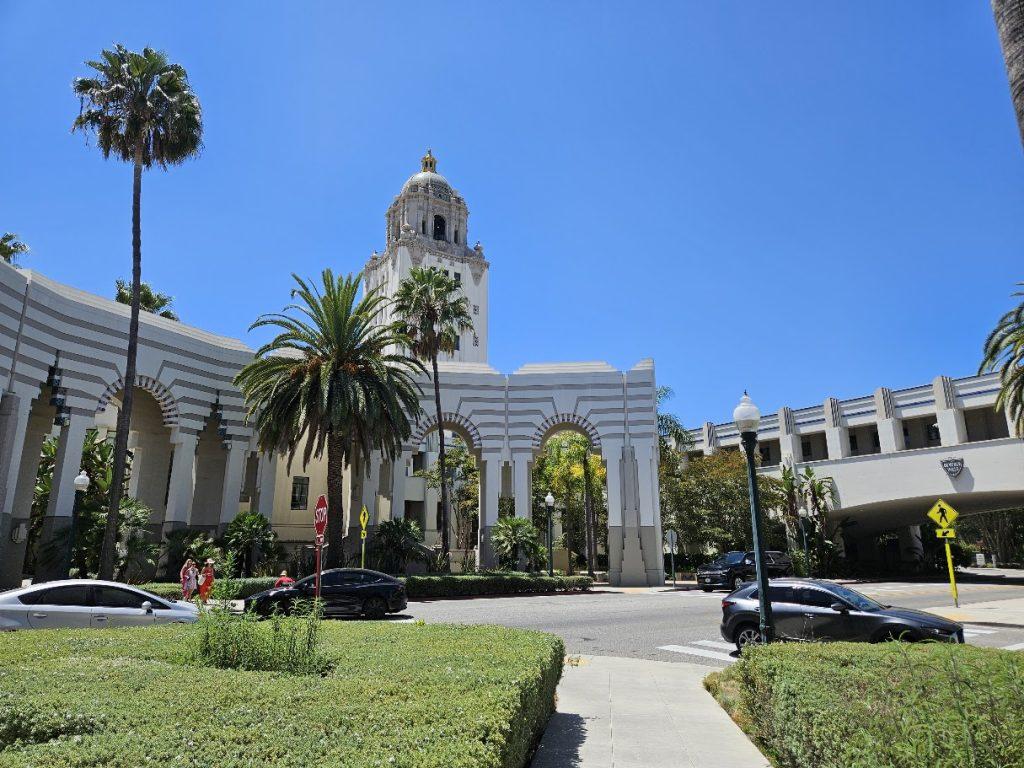
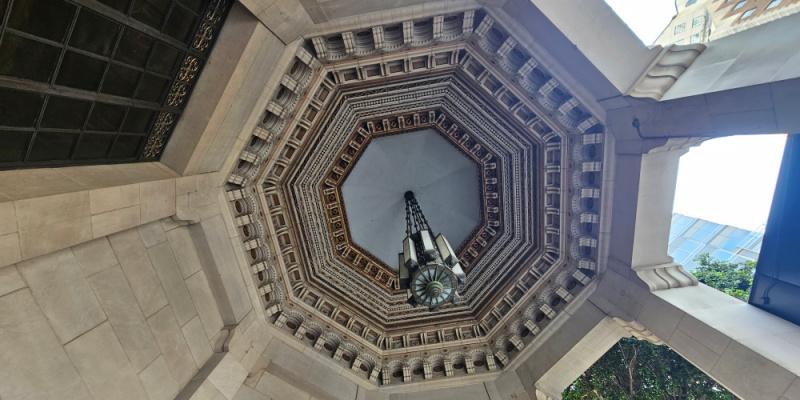
You can’t miss the Beverly Hills City Hall when you drive into the complex. It was completed in 1932 and designed by architect William J. Gage in the Spanish Renaissance style. The low classical base symbolizes government while the eight-story tower represents commerce. At the top is a tiled dome with a gilded cupola.
The inside is closed on weekends, but if you have a chance to go inside on a weekday, you will notice its terrazzo floors, marble walls, and decorative ceilings. It was carefully restored in 1982 and set the stage for the expansion of the Civic Center, completed in 1990.
The Civic Center complex
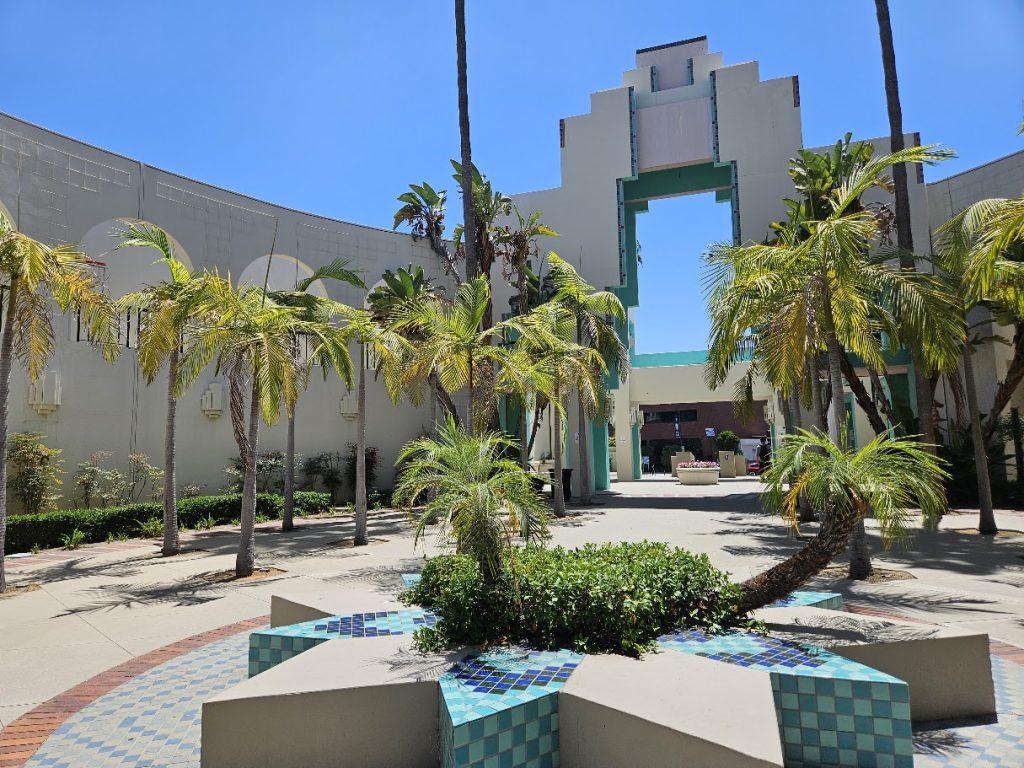
Architects who competed to expand the civic center included Frank Gehry, Moshe Safdie, and Arthur Erickson. The winner was Charles Moore with the Urban Innovations Group, who worked with A.C. Martin and Associates.
Moore was known for his American Postmodern design. Instead of creating an entirely separate modern civic center that clashed with the old City Hall, his completed design combines Spanish Revival, Art Deco, and Postmodern elements.
Beverly Hills Public Library
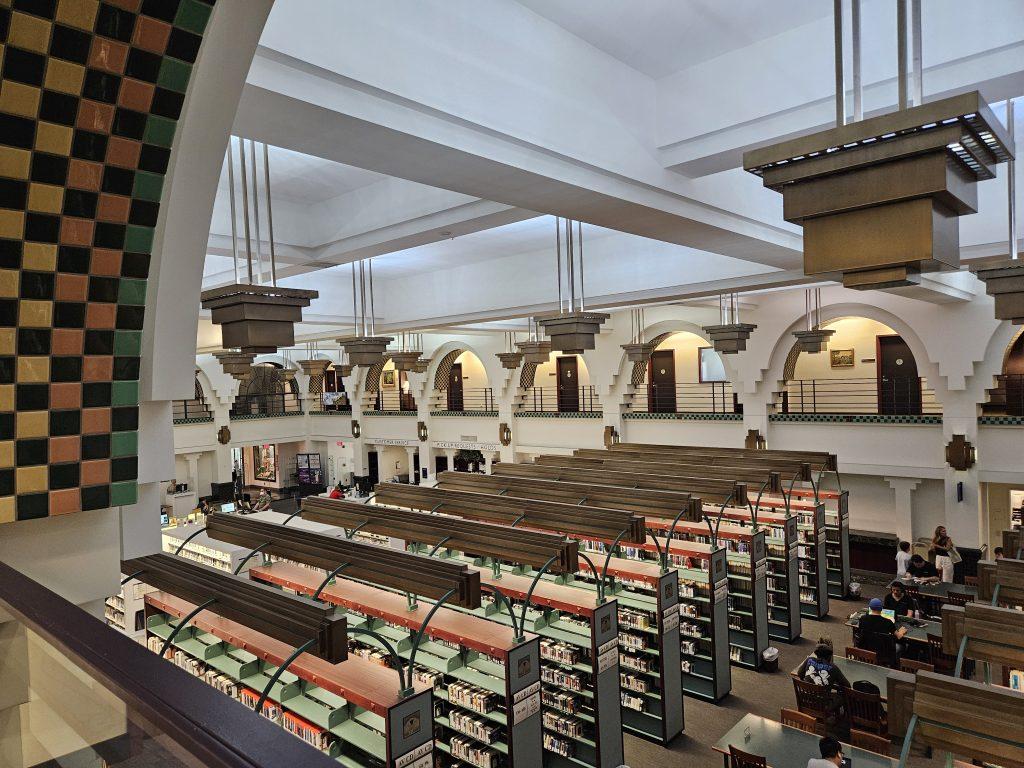
Moore designed the library, which contains about 200,000 volumes and receives more than 51,000 visitors per month. It is free to use for any residents of Los Angeles, Orange, and Ventura counties with proof of ID and address.
The library is volunteer-run with proceeds benefiting library programs. Inside is Kelly’s Coffee & Fudge Factory. There is also an enchanting children’s reading and events room. If you are interested in Beverly Hills history, including local celebrities, you can find plenty of resources there.
The Paley Archive, assembled by the Paley Center for Media, is a huge collection of more than 160,000 television and radio programs and ads spanning more than a century.
Beverly Hills Police Department
The official Beverly Hills Police Department has been operating since 1927. In the early days, both the police and Fire Department were housed in Deputy City Marshal Jack Munson’s home. When the original City Hall opened in 1932, the Police Department moved into the building. After the expansion of the Civic Center in 1990, the BHPD moved into its current headquarters directly across from City Hall.
It was all part of Moore’s master plan. Curved colonnades, promenades, and landscaped courtyards were used to tie all the buildings together.
Public Art at the Civic Center
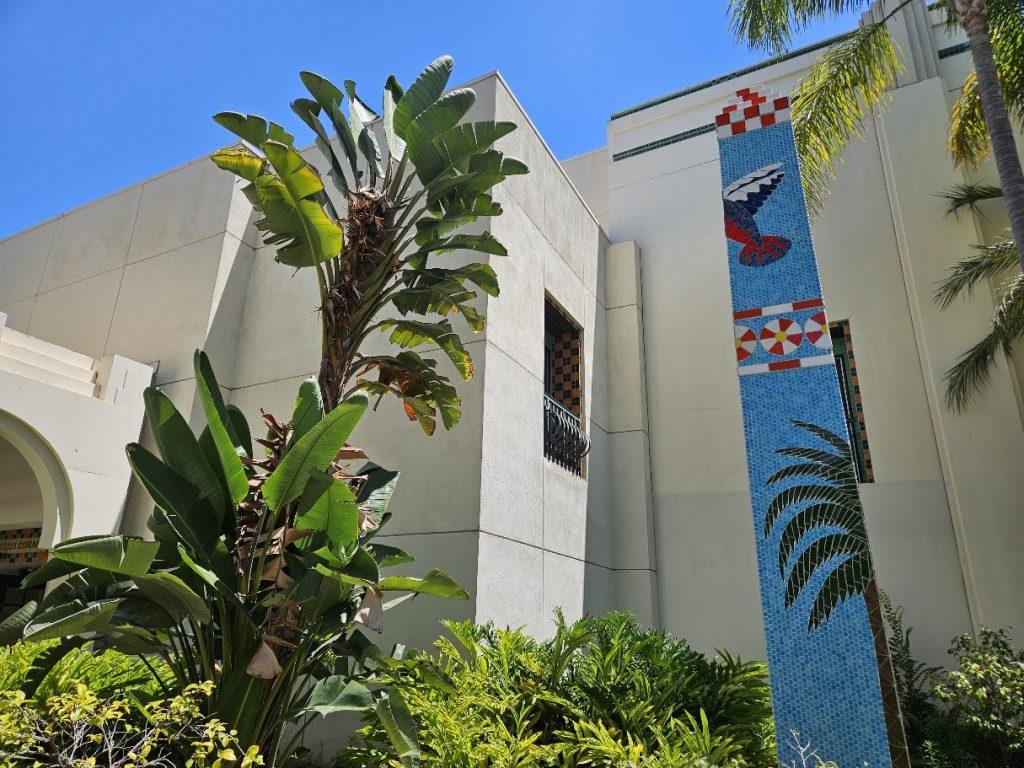
There are several public art displays outside the Civic Center. They include a Center Obelisk on the north exterior of the library, Home is an eight-foot bronze work by Charles Arnoldi near the library grounds, and Iron Root, by Ai Weiwei, is located toward Santa Monica Boulevard.
Hollywood filming location
You may have seen the Beverly Hills City Hall in films like the Beverly Hills Cop franchise and others.
Other nearby sites to visit
Continuing your stroll near the Civic Center toward Beverly Gardens Park, the Beverly Hills sign and Rodeo Drive, you may want to check out the former Beverly Hills Post Office, now the home of the Wallis Annenberg Center for the Performing Arts, a 70,000 square foot facility.
The Paula Kend Meehan Historic Building, dating back to the 1930s in Italian Renaissance Revival style, is part of The Wallis complex and is an interesting architectural counterpoint to the Moore Postmodern Civic Center. It houses a 150-seat studio theater, an arts education school, a gift shop, a café, and administrative offices.
Places to Stay
Click on the map below.

Leave a Reply