
I’ve attended plays at CASA 0101 Theater a bazillion times. (slight exaggeration – Okay, big exaggeration) Each time I did, I learned something new and enlightening about the Chicano/Latino community. I wish the people who are gung-ho on the mass deportation that is going on right now would trek to Boyle Heights to educate themselves on this colorful and vital community.
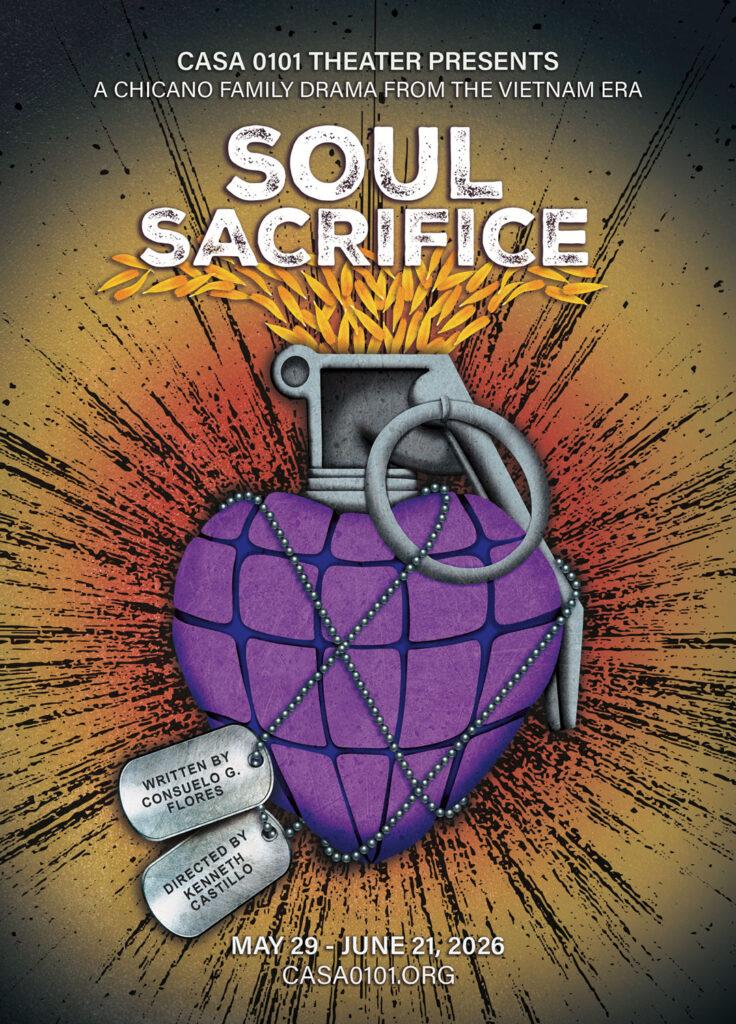
CASA 0101’s most recent offering is the World Premiere of Consuelo G. Flores’s play “Soul Sacrifice.” In it, she remembers how her family dealt with her brother being drafted to fight in the Vietnam War. I graduated from high school in 1971, so I vividly remember the protests, fear of the draft, and graphic news reports about the war.
But my experience was not the same as those living in the inner city. My family resided in the mostly white neighborhood of Costa Mesa. Some of the boys I knew were drafted, but many received college deferments or claimed to have conditions like “bone spurs.”
Such was not the case in brown and black neighborhoods. Young boys were drafted in large numbers, but many did not return because they were the first to be put in harm’s way. They were blown to smithereens, returned with horrendous injuries, or survived with severe PTSD.
In Soul Sacrifice, Connie, played by Myrna Velasco, is the playwright Consuelo. When she was 9 years old, her brother Luie, played by Carlos Pratts, was drafted and sent to boot camp without being able to say goodbye to their parents.
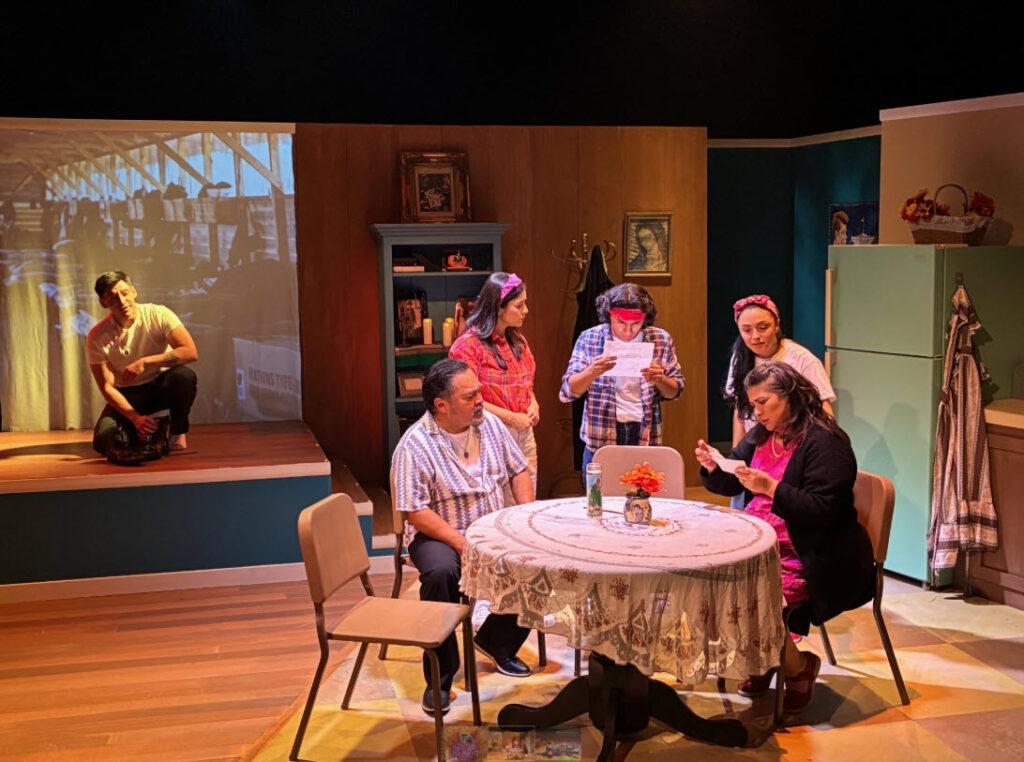
Itzel Ocampo (Rachel Flores), David Flores (Ben Flores), Myrna Velasco
(Connie Flores) and Karla Ojeda (Guadalupe Flores – Mom) in the World Premiere Production of Soul Sacrifice, written by Consuelo G. Flores, directed by Kenneth Castillo, produced by Emmanuel Deleage, presented at CASA 0101 Theater, May 29 – June 21, 2026, www.casa0101.org – Photo by Steve Moyer Public Relations
As a mother of an Airman, I cannot imagine this happening, but it did. Luie is assigned to be a “scout” and experiences the worst of the war in terms of seeing and causing death and harm. The family barely hears from him until his tour of duty is completed and he returns home emotionally damaged.
While he is away, his brother Ben, played by David Flores, becomes involved with the “brown berets” who organized protests against the war. At one point, Connie, her sister Rachel, played by Itzel Ocampo, and Ben attend the National Chicano Moratorium March in 1970. Police tear-gassed and shot at the crowd, killing civil rights activist and reporter for the Los Angeles Times, Ruben Salazar, among others.
Ben remarks that people were horrified to learn about the deaths of the four students who were killed at Kent State University in Ohio, but the Chicano protest was viewed as a “vicious riot.” Sound familiar?
Connie’s mother, Guadalupe, played by Karla Ojeda, and her father, José, played by Martín Morales, dealt with the fear and suffering in their own ways. They had both come to America as immigrants seeking a better life for their family and felt guilt that their son had to fight in America’s senseless war. Many of their neighbors lost their sons, and Rachel lost her boyfriend.
Guadelupe relied on prayer while Jose, a slaughterhouse worker, turned to heavy drinking.
When Luie returned from the war, the family did not understand the depth of his suffering and didn’t know what to do to help him. Even small sounds set him off, causing him to “hit the floor” with fear.
The play also touches on family dynamics at the time. Connie and Ben were able to go to college and make something of their lives, while Rachel remained unmarried, taking care of her parents. Luie disappeared to Arkansas for several years, reemerging at the father’s funeral with an entirely new family.
The production, directed by Kenneth Castillo, is emotionally riveting. It is an important story that highlights the role black and brown immigrants and citizens played in fighting the Vietnam War and the impact it had on families and communities.
The production has one week to go as of this writing, but if you can catch it, it will be worth it. All of the actors are first-rate and authentically truthful in their roles. As Connie, Myrna Velasco is an adult playing a child during much of the play, which can be difficult, but she believably embodies her character.
CASA 0101 Theater – 2102 E. 1st St., Los Angeles, CA 90033 | Information

Leave a Reply