
When I told my Millennial daughter and son-in-law that I went to see Fernandomania at CASA 0101 Theater in Boyle Heights, they asked,” Who’s Fernando Valenzuela?” I was flabbergasted. If you are at least 40, have been in Los Angeles for a while, or are an avid baseball fan, you know who Fernando was. I guess I didn’t realize how much time had gone by since he took the Dodgers by storm as one of the best pitchers ever to play the game.
Fernando Valenzuela, nicknamed El Toro, was born in Etchohuaquila (Sonora), Mexico, in 1960 to poor farmers and was one of 12 children. A baseball scout sent a team to evaluate a shortstop named Ali Uscanga in Mexico. Valenzuela threw several balls to Uscanga, and the scout realized he had discovered a star pitcher.
Fernando was 20 years old when he signed with the Dodgers on July 6, 1979, and the rest is history. He played major league baseball from 1980 through 1997, winning the World Series in 1981, was the MLB strikeout leader, and won the Cy Young and Rookie of the Year Awards.
He was the first Mexican pitcher to play for the Los Angeles Dodgers, although another Sonoran, Mel Almada, pitched for the Brooklyn Dodgers in 1939. Valenzuela was an inspiration to his Chicano fans through his rise to stardom and the cultural phenomenon known as “Fernandomania.” He increased the percentage of Mexican-American Dodger fans from 5% to 50%.
Valenzuela sadly died on October 22, 2024, at the age of 63, and Los Angeles muralist Robert Vargas memorialized him on a building in Boyle Heights.
Fernandomania at CASA 0101
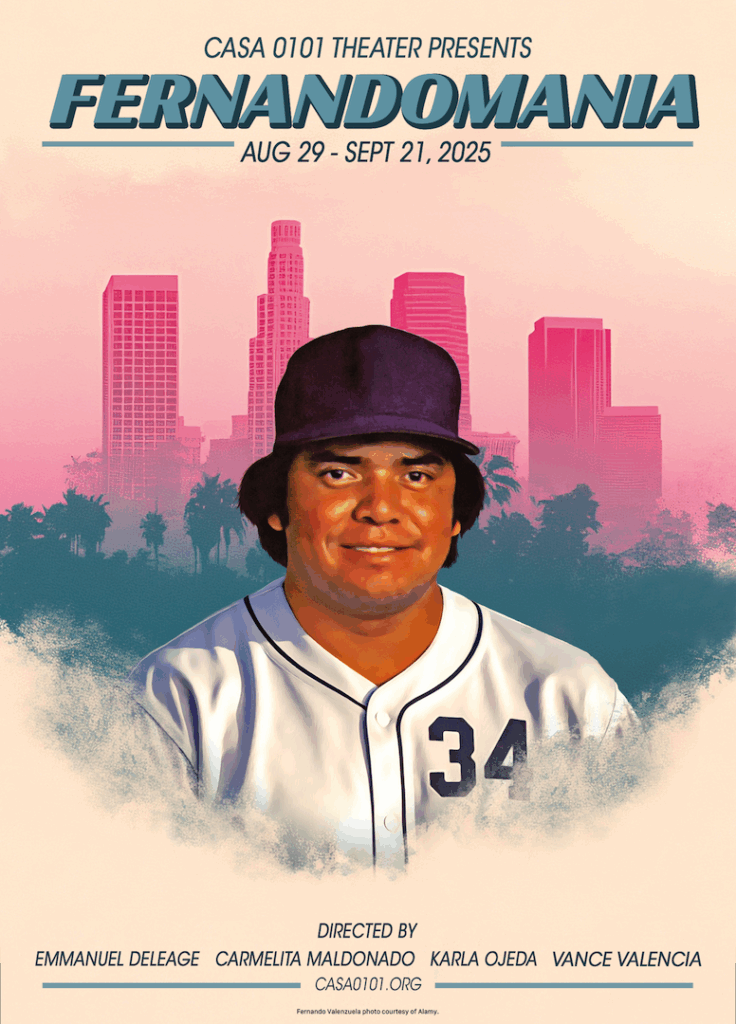
Fernandomania is a collection of 12 ten-minute one-act plays running August 29 – September 21, 2025, at CASA 0101 in Boyle Heights. Various authors and directors worked on the one-acts.
Directors are Emmanuel Deleage, Carmelita Maldonado, Karla Ojeda, and Vance Valencia.
Writers are Josefina López, María Fernanda Valenzuela, Oscar Arguello, Chris Banda, Gloria Isabel Briseño, Ignacio González, Kimberly Huff, José Luis López Jr., Christopher John Magallanes (aka Don Heusos), Celina Martínez, Michael St. Onge y Dr. Connie Valencia.
The production was created by Josefina López (founder of CASA 0101) and Dr. Connie Valencia.
The plays are vignettes, including Valenzuela’s beginnings, his wife, and the impact he made on his fans. The creation of the Fernando Valenzuela mural by Robert Vargas, played by Eugene Antonio Negrete, is interspersed throughout the performance.
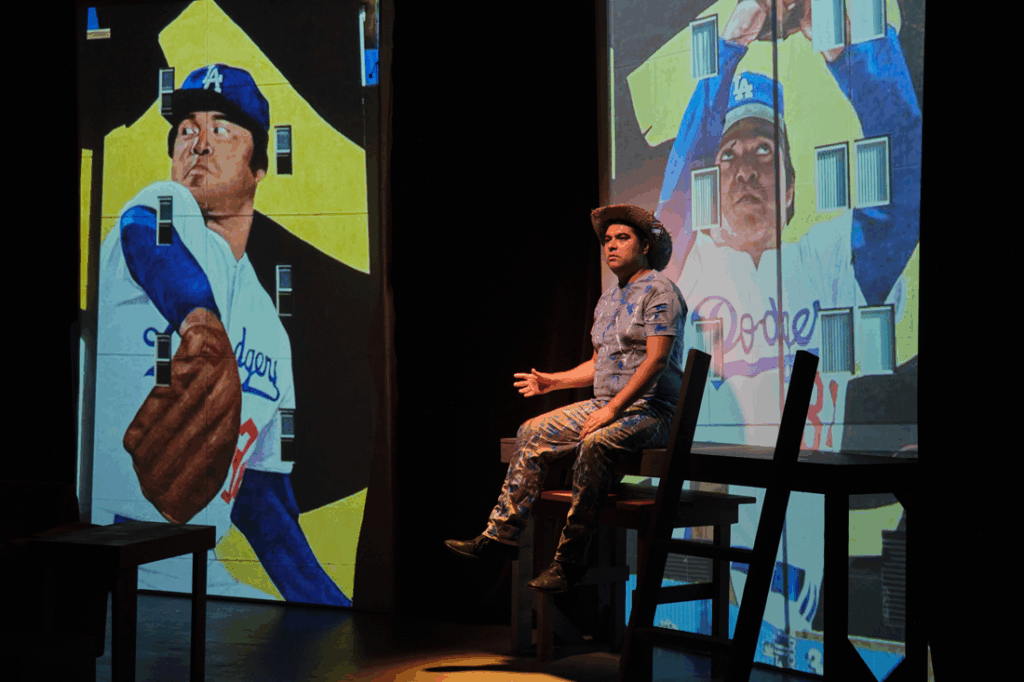
Edward Navarrete plays Valenzuela. He is similar in build, which was not that of a typical athlete. Navarrete inhabits Valenzuela’s personality. An insider describes Valenzuela as a dynamic human being. He had a dry humor and was easygoing.
The ensemble cast plays multiple roles, and all were cohesive to the stories. Impressive performances include those of Gabriela Pedraza and Itzel Ocampo, who hilariously carry off two young boys; and Martin Morales and Laura Vega, who each play several older characters with both comedic and dramatic expertise.
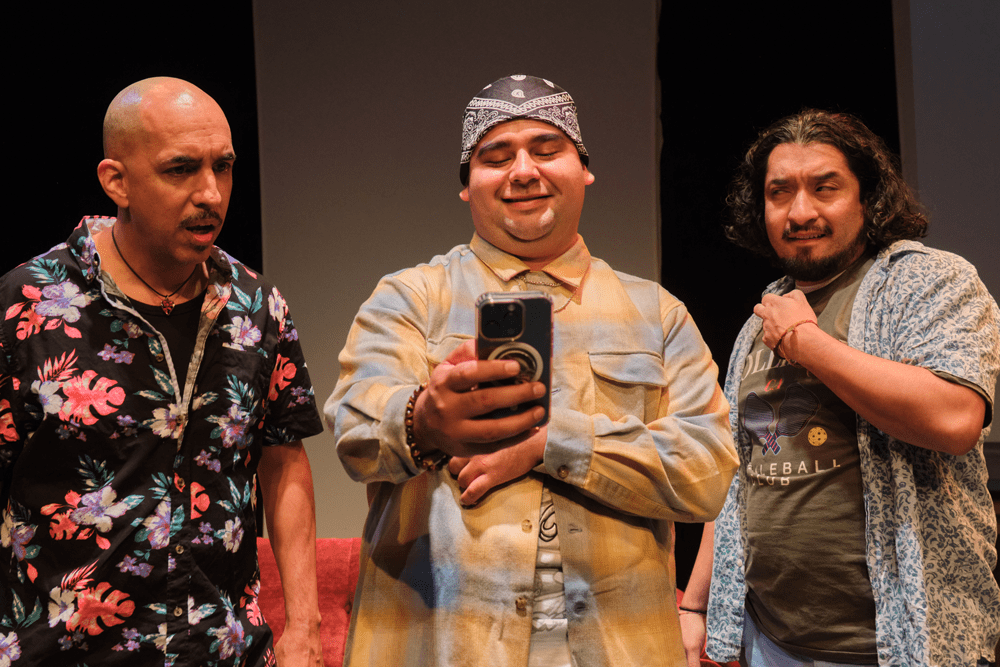
In the photo below, Edward Navarette, Gabriel Montoya, and Jose Nateras have a funny scene as Navarette plays a Chicano who strives to be more Chicano even though he lives in La Habra.
There were a few mentions of ICE raids and the current administration, and, to be honest, I wish there were more, considering the recent Supreme Court ruling on ICE and racial profiling, which lifted the limits imposed by a federal judge in Los Angeles. One great line was “If you voted for Trump, turn in your Chicano card.” With people with brown skin being disappeared on the streets daily, that is appropriate.
It makes one wonder if Fernando were pitching today, would he be deported?
CASA 0101 is an important theatrical venue that more Angelenos should support because its performances educate audiences on the Chicano experience from a deep and reflective human perspective.
If you can donate to support CASA 0101, please click the QR code below.
The Dodger organization should be grateful that Fernando Valenzuela existed, increased its fanbase, and brought victories that will always be remembered. Especially after the Chavez Ravine community of immigrants was unjustly uprooted to build its stadium.
Leave a Reply